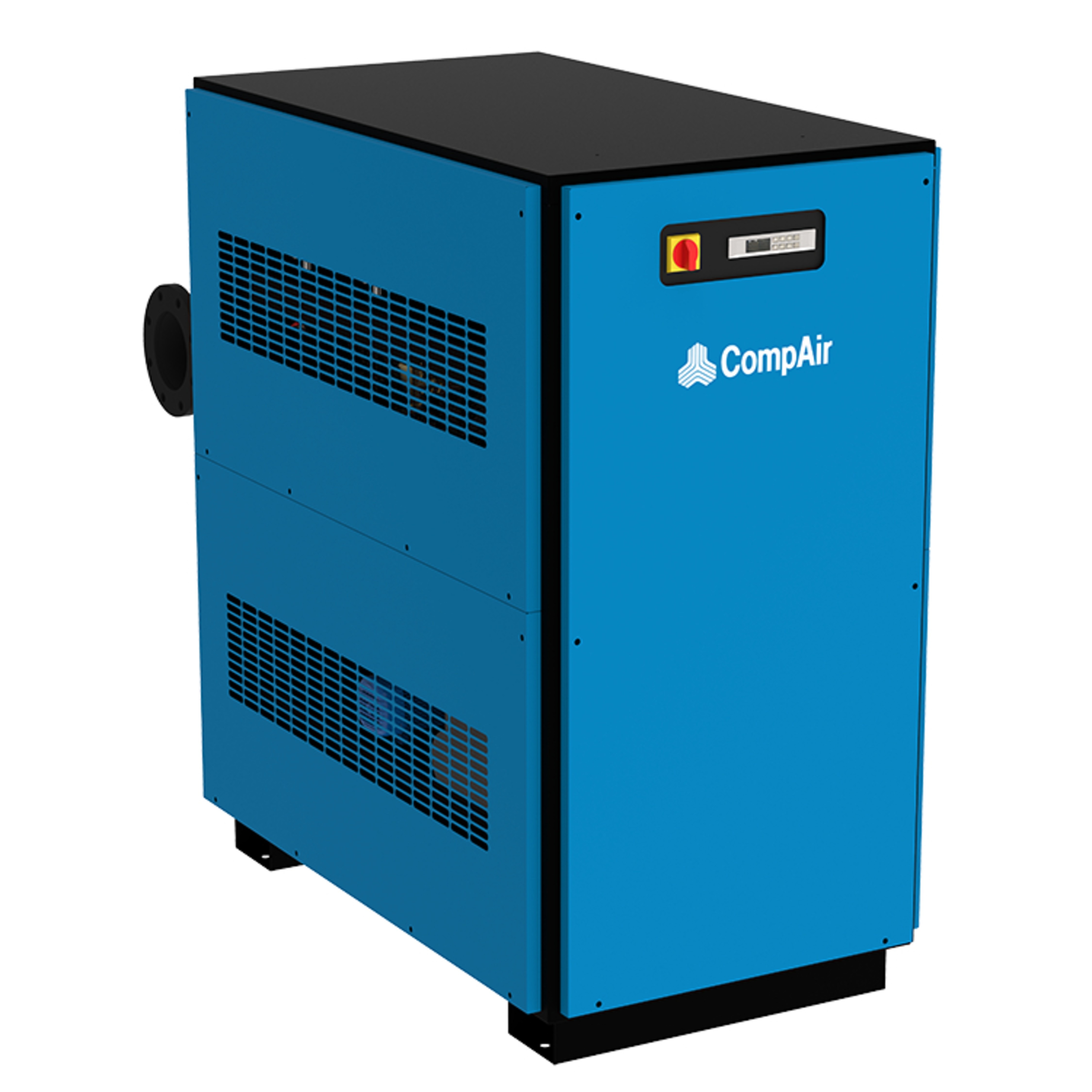
Refrigerant Compressed Air Dryer
Cycling Refrigeration Dryers
Energy Saving CDF-ES Series
High efficiency air treatment
The cycling dryer is designed to deliver the lowest cost solution by focusing on all of the cost contributors. In a typical compressed air dryer, the refrigerant compressor runs continuously regardless of demand. With a cycling dryer, circulating glycol cools the compressed air allowing the refrigerant compressor to turn-off during low demands, to save energy and cost
The cycling dryer is ideal for partial airflow demand, where the compressed air demand on the network goes up and down over time.
These all new dryers deliver consistent high performance along side optimised energy efficiency, increased environmental credentials and a lower total cost of ownership.
They are a step ahead of both the EU and the competition – supporting sustainability with low GWP refrigerants for ISO Class 4 (+3°C PDP) markets.
Compared to previous models, this next-generation of dryers deliver:
Reduced power consumption of up to 10%
Up to 27% lower pressure drop
Significant footprint reduction of up to 40%
Reliable and Simplistic Design
Microprocessor control and no-loss Smart Drain increase reliability, while dryer self-regulation, plug-and-play installation and readily available parts make for simple and easy maintenance.
Innovative Control Panel
With all the main functions you would expect to control and monitor the unit:
Anti freeze mode – shuts dryer off to avoid icing
Alarm display: Dew Point, high/low temperature, High ambient temperature
Remote ON/OFF optional up to CD160F-ES, standard from CD216F-ES
Alarm history
Condensate drain management
Ready for Industrial IOT with adoption of iConn, remote monitoring, preventive maintenance, free cloud portal
New 3-layer Heat Exchangers
Designed and developed in our laboratories to deliver the highest levels of performance with the lowest pressure drop. The adoption of the new CompAir heat exchanger has enabled the removal of the inlet and outlet headers.
How it works (step by step)
Hot, wet compressed air enters the dryer
Air passes through an air-to-air heat exchanger (pre-cooled by outgoing dry air)
Air is further cooled by a refrigeration circuit (evaporator)
Moisture condenses into liquid water
Condensate is removed via an automatic drain
Dry air is reheated slightly and sent downstream
Unlike non-cycling dryers (which run constantly), cycling dryers adjust refrigeration based on demand.
Uses a thermal mass (glycol or aluminum block) to store cooling
The compressor cycles on/off depending on load
Saves energy during low or fluctuating air demand
Key benefits
✅ Lower energy consumption
✅ Longer compressor life
✅ Stable pressure dew point (typically +3°C / +37°F)
✅ Ideal for variable-load systems
Typical applications
Manufacturing plants
Automotive workshops
Food & beverage (non-contact air)
General industrial compressed air systems
Cycling vs Non-Cycling (quick compare)
Feature Cycling Dryer Non-Cycling Dryer
Energy efficiency ⭐⭐⭐⭐ ⭐⭐
Load adaptability Excellent Poor
Initial cost Higher Lower
Operating cost Lower Higher