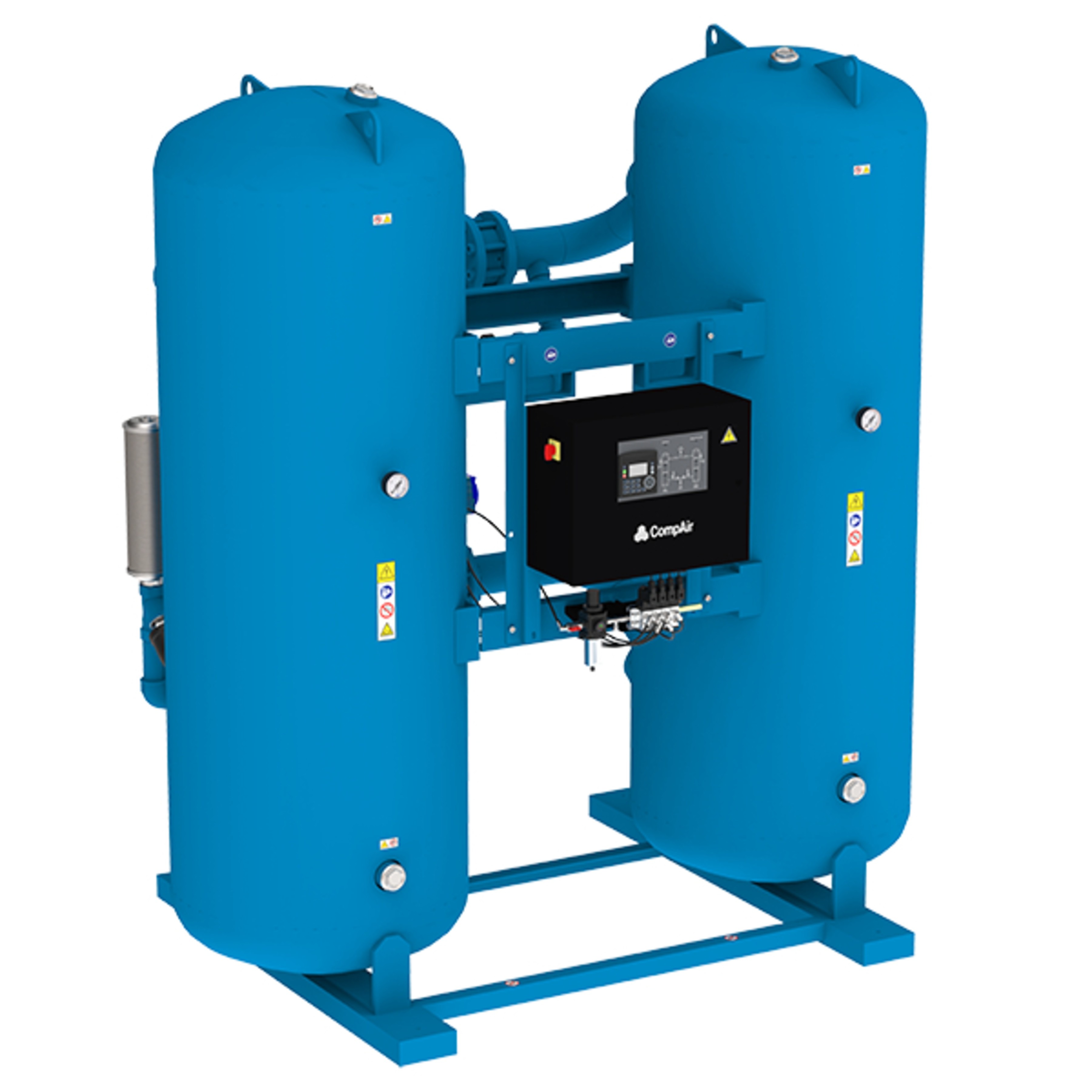
Compressed Air Dryers
Twin Tower Heatless Desiccant Dryers
The CompAir AX-Series uses twin desiccant towers and strategically positioned valves to dry the compressed air.
The compressed air produced is thoroughly dried as it is directed through the on-line desiccant-filled tower of the dryer. As the desiccant in this tower adsorbs moisture from the air, the desiccant in the dryer’s offline tower is purged of moisture and readied for use.
Advantages at a glance:
High Reliability - proven technology used in thousands of applications and installations worldwide.
Low Capital Investment - large range, available for precise sizing to suit your needs.
High Air Quality - pre and post filter included, helping you to meet stringent air quality requirements.
Energy Efficient - with the optional high efficiency Energy Management System (EMS) offers even greater efficiency.
Standard features include:
High Efficiency Pre Filter and Dust Filters
IP54 electrical enclosure
Digital controller
Tower pressure gauges
Colour change moisture indicator
Optional features include:
Energy Management System (EMS) with dew point display
Fail-to-Shift alarm - Monitors the dryer sequencing functions to ensure proper dryer operation by sensing the pressure in each tower, sending an alarm in case of anomalies. This option is available from models 1000m3/h and above
IP65 electrical rating plus stainless steel control box
4-20 mA signal (requires EMS) is available should you need to get 4-20mA to your SCADA system
Different tower vessels design code
Stainless steel control air tubing
Filter monitoring - Differential pressure switches installed on filter monitor performance. Display options include analog and digital
-70˚C pressure dew point
No air loss drain for filters with alarm
Marine paint
A compressed air dryer removes moisture from compressed air. When air is compressed, its temperature rises and then cools — causing water vapor to condense. Without drying, that moisture leads to:
Corrosion in pipes and equipment
Product quality issues
Freezing in cold climates
Contamination of systems
A Twin Tower Heatless Desiccant Dryer uses two vessels (towers) filled with desiccant material to remove moisture.
While one tower is drying (adsorption), the other is regenerating (desorbing moisture), and they alternate continuously.
Key points:
Heatless: Regeneration doesn’t use external heating — it uses a portion of the dried compressed air as the regeneration gas.
Desiccant-based: Silica gel, activated alumina, or molecular sieve is the drying medium.
Continuous drying: One tower always produces dry air.
📌 3. Core Components
Component Function
Twin Towers (Vessels) Hold desiccant for drying and regeneration
Desiccant Material Adsorbs moisture from compressed air
Inlet/Outlet Valves Direct air into appropriate tower
Purge Control System Regulates regeneration airflow
Check & Isolation Valves Prevent cross flow
Filters Protect desiccant from oil & particulate
Pressure Gauges / Dew Point Indicators Monitor performance
Automatic Timer or Electronic Controller Controls tower switching
📌 4. How It Works: Step-by-Step
🟢 Drying Phase (Adsorption)
Incoming wet compressed air enters Tower A.
Moisture molecules bind to desiccant surface (adsorption).
Dry air exits toward plant piping.
🔵 Regeneration Phase (Desorption)
Tower B (previously saturated) is taken offline.
A small portion (usually 10–15%) of the dried compressed air is expanded to near atmospheric pressure.
That air flows backwards through the desiccant, carrying moisture out.
Moist air is vented to the atmosphere.
🔄 Tower Switching
After a set time or dew-point trigger, the towers switch roles.
This process continues automatically.
📌 5. Key Performance Terms
Term Meaning
Dew Point Temperature at which moisture condenses — lower is drier
Purge Loss % of dry air used for regeneration
Cycle Time Duration per tower before switching
Pressure Drop Loss of air pressure across the dryer
Flow Capacity Air volume the dryer can handle (e.g., 50 m³/min)
Typical heatless desiccant dryers reach dew points of –40°C to –70°C (or drier if needed). Lower dew points are required in demanding industries like pharma or instrumentation air systems.
📌 6. Why Use Heatless Desiccant Dryers?
✅ Advantages
Lowest attainable dew points without external heater
Simple design — reliable, fewer moving parts
No external heat source — safer in hazardous areas
Good for intermittent or variable loads
Long service life
⚠️ Limitations
Purge air loss: 10–15% of dry air is consumed in regeneration
Energy cost: Because purge air is “lost, ” utility size must be larger
Desiccant replacement: Periodic desiccant change is required
Not ideal for very high flow rates without significant purge
📌 7. Desiccant Types
Type Best Use Typical Dew Point
Activated Alumina General purpose drying –40°C
Silica Gel Moisture removal near ambient –40°C to –60°C
Molecular Sieve Ultra low dew points –70°C and bel