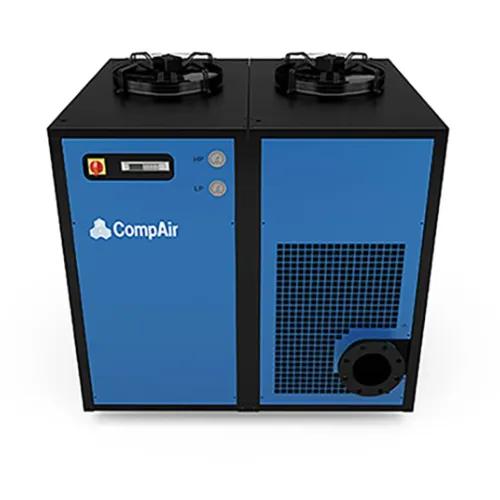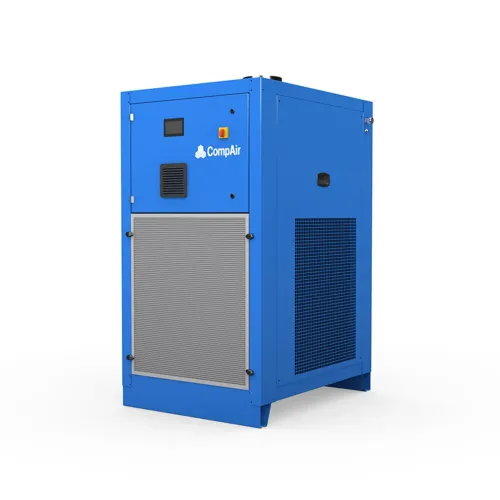
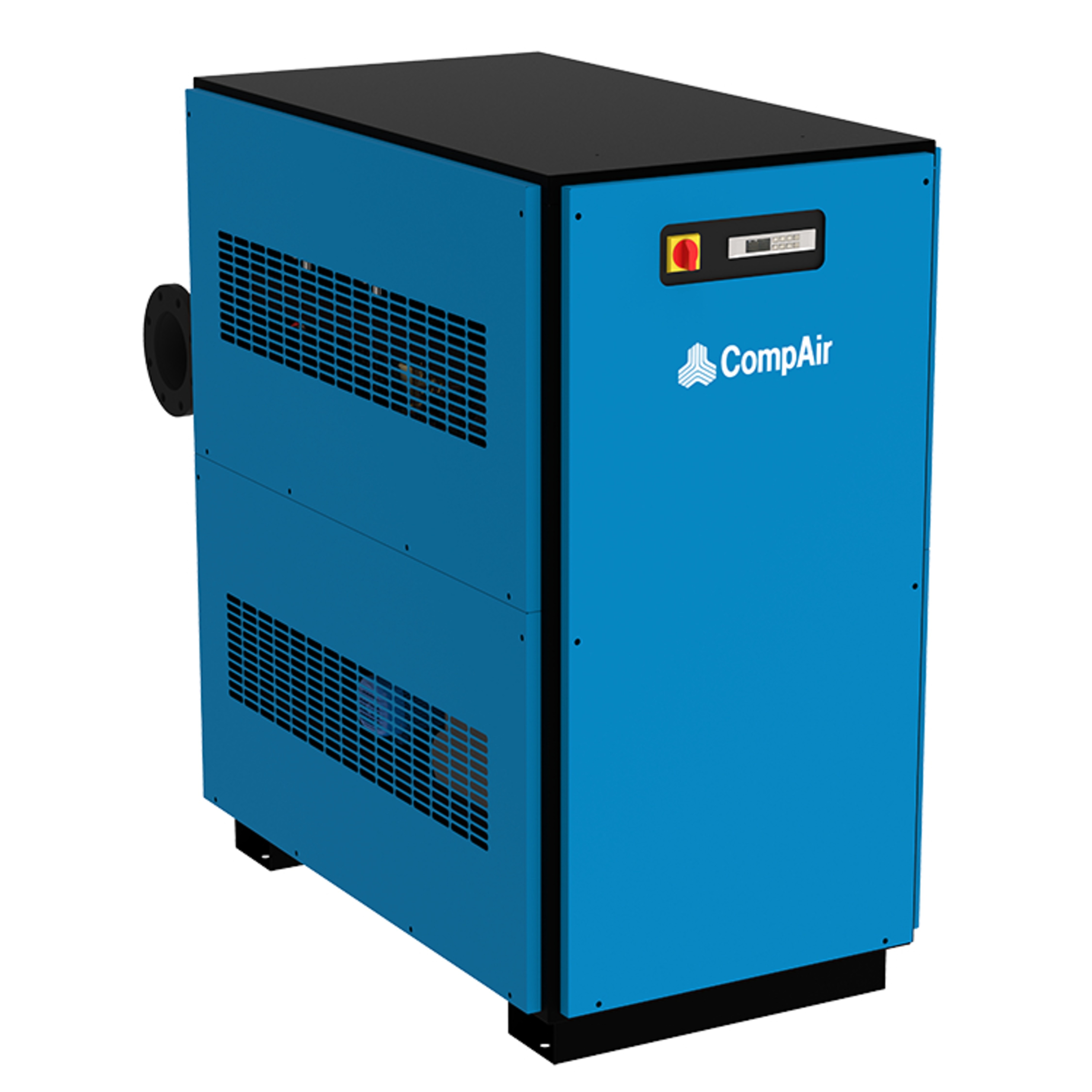
Refrigerant Compressed Air Dryer
Cycling Refrigeration Dryers
Energy Saving CDF-ES Series
High efficiency air treatment
The cycling dryer is designed to deliver the lowest cost solution by focusing on all of the cost contributors. In a typical compressed air dryer, the refrigerant compressor runs continuously regardless of demand. With a cycling dryer, circulating glycol cools the compressed air allowing the refrigerant compressor to turn-off during low demands, to save energy and cost
The cycling dryer is ideal for partial airflow demand, where the compressed air demand on the network goes up and down over time.
These all new dryers deliver consistent high performance along side optimised energy efficiency, increased environmental credentials and a lower total cost of ownership.
They are a step ahead of both the EU and the competition – supporting sustainability with low GWP refrigerants for ISO Class 4 (+3°C PDP) markets.
Compared to previous models, this next-generation of dryers deliver:
Reduced power consumption of up to 10%
Up to 27% lower pressure drop
Significant footprint reduction of up to 40%
Reliable and Simplistic Design
Microprocessor control and no-loss Smart Drain increase reliability, while dryer self-regulation, plug-and-play installation and readily available parts make for simple and easy maintenance.
Innovative Control Panel
With all the main functions you would expect to control and monitor the unit:
Anti freeze mode – shuts dryer off to avoid icing
Alarm display: Dew Point, high/low temperature, High ambient temperature
Remote ON/OFF optional up to CD160F-ES, standard from CD216F-ES
Alarm history
Condensate drain management
Ready for Industrial IOT with adoption of iConn, remote monitoring, preventive maintenance, free cloud portal
New 3-layer Heat Exchangers
Designed and developed in our laboratories to deliver the highest levels of performance with the lowest pressure drop. The adoption of the new CompAir heat exchanger has enabled the removal of the inlet and outlet headers.
Glycol Pumps
Provides a constant circulation of glycol with the compressor on or off.
Innovative No-loss Smart Drain
Fitted as standard, a sensor is installed directly in the moisture separator and control logic is managed by the main Control Panel.
Please download the brochure under the downloads tab to learn more about how these cycling dryers work.
🛠️ Best Options by Application
Ingersoll‑Rand D170it Compressed Air Dryer – Premium industrial dryer ideal for medium-large air compressor systems and continuous operations.
Refrigerant Compressed Air Dryer, 250 CFM – Solid midsize unit for workshop or production settings.
Refrigerated Air Dryer 20 CFM & Refrigerated Air Dryer 60 CFM – Budget-friendly, light-duty dryers for small shop compressors.
Refrigerant Air Dryer ‑ S Series & Compressed Air Dryer ‑ Refrigeration Dryer – General purpose refrigerant dryers suitable for varied small-to-medium use.
🔄 Cycling vs. Non-Cycling Refrigeration Dryers
There are two main types of refrigerant dryers:
🔁 Cycling Refrigeration Dryers
How they work: The refrigeration compressor runs only when needed, turning off when the cold storage medium (like a thermal mass or glycol tank) is chilled, and restarting when temperature rises.
Key benefit: Better energy efficiency — they reduce electrical usage during low demand or idle times.
Best for: Systems with variable air flow or intermittent compressor use.
Pros
Lower energy costs over time
Good for systems with fluctuating demand
Cons
Slight dew point variations depending on load
Usually higher initial purchase cost than non-cycling models
⚙️ Cycling dryers are often called thermal mass or energy management dryers because they store cold and cycle refrigeration compressors intelligently.
🔄 Non-Cycling Refrigeration Dryers
How they work: The refrigeration compressor runs continuously regardless of demand, regulating with valves but never stopping.
Key benefit: Delivers a stable, continuous dew point.
Best for: High-duty systems with constant airflow.
Pros
Constant dew point performance
Simpler control design
Cons
Higher energy consumption at part-load or idle
🧠 How Refrigeration Dryers Work (Simple Overview)
Warm compressed air enters the dryer and is precooled.
Refrigeration cooling cools the air further so moisture condenses out.
Condensed water is separated and drained automatically.
Air reheating warms the dry air before it exits to prevent condensation downstream.
This process typically yields dry air at about +3 °C dew point in many industrial units.
🛠️ Why Use a Refrigerant (Cycling) Dryer?
✔ Protect Equipment & Tools
Moisture in compressed air leads to rust, corrosion, stuck valves, and other problems in pneumatic systems.
✔ Improve Product Quality
Dry air improves consistency in processes like painting, packaging, and instrumentation.
✔ Save Energy (Cycling Models)
Cycling dryers reduce electricity use when dema