Desiccant Air Drying Technologies
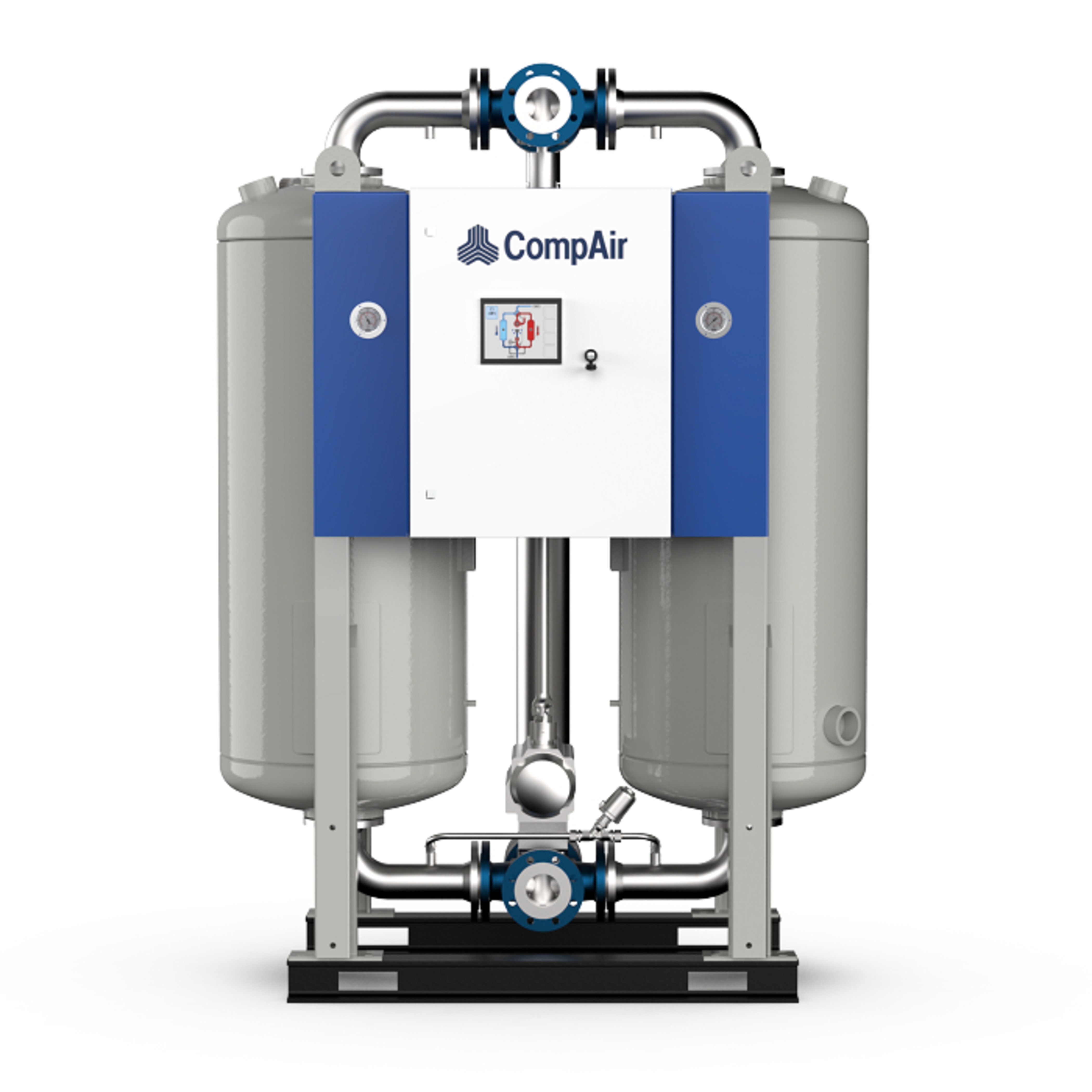
ATVT Adsorption Dryers
Vacuum Regeneration Adsorption Dryers
Vacuum regeneration dryers do not use process air to regenerate the adsorbent desiccant material, instead they use ambient air for both regeneration and cooling (reducing energy consumption and process air loss). For regeneration, the ambient air is heated and pulled across the desiccant bed using a vacuum pump. To cool the desiccant and ensure it is at the optimum temperature for adsorption, the heat source is simply removed, and the desiccant cooled to ambient temperature. Vacuum regeneration dryers can be supplied with electric heaters or heat exchangers that utilise existing heat sources on site (steam, hot oil, etc.)
Features
CompAir ATVT dryers provide a constant outlet dewpoint in accordance with ISO8573-1
Air quality is enhanced when installed with CompAir High Efficiency Coalescing pre-filtration and General Purpose Dry Particulate post filtration
No process air is used during regeneration & cooling of the desiccant material, reducing energy consumption
Regeneration under vacuum further improves energy efficiency
Can utilise existing heat sources (eliminating need for electrical heater) to further reduce energy consumption by using the following options: steam regeneration, steam / electric regeneration or hot water / electric regeneration
Thermal insulation for reduction of heat loss and touch protection fitted as standard
Full feature electronic control with dewpoint display and Energy Saving Technology fitted as standard
Large flow capacities
🌬️ 1) Desiccant Air Drying Technologies (Overview)
Desiccant dryers remove moisture from compressed air by adsorption — water vapor sticks to the surface of a dry solid (the desiccant).
Unlike refrigerated dryers (which cool air), desiccant dryers can deliver very low dew points (e.g., −40 °C, −70 °C or lower), which are required in many industrial processes where moisture can damage products, equipment, or pneumatics.
Key benefits:
Deep dew point control
Stable performance under varying loads
Suitable for critical processes (pharma, electronics, instrument air)
Basic types:
Heatless (purge air regenerates desiccant)
Heated (external heat regenerates desiccant)
Vacuum Regeneration Adsorption Dryers
ATVT Adsorption Dryers (Advanced type)
🌀 2) ATVT Adsorption Dryers
ATVT = Advanced Twin-Vessel Technology
This is a specialized variation of traditional twin-tower desiccant dryers. Rather than purely time-based switching, ATVT systems incorporate intelligent control and advanced flow dynamics to maximize adsorption efficiency and minimize regeneration losses.
How ATVT works (in general):
Drying cycle: Moist compressed air enters one desiccant vessel and water vapour is adsorbed.
Regeneration cycle: The other vessel is being regenerated at the same time.
Instead of a simple timer switch, ATVT uses flow optimization, pressure and/or dew-point feedback to determine the precise switch point — leading to:
Longer useful life of desiccant
Reduced energy and air consumption
Stable, reliable dew-point performance
Typical advantages:
✔ Higher effective adsorption capacity
✔ Lower purge or energy use than conventional systems
✔ Better performance when demand fluctuates
✔ Often paired with advanced controls (e.g., dew-point monitoring)
Where used:
Industries requiring consistent very dry air with variable loads, such as:
Chemical processing
Painting & powder coating
Instrument air for automation
🌫️ 3) Vacuum Regeneration Adsorption Dryers
Vacuum Regeneration Adsorption Dryers regenerate the desiccant by pulling a vacuum (negative pressure) on the desiccant bed rather than (or in addition to) using heated air. This approach significantly lowers the energy and compressed air required to strip the moisture from the desiccant.
How vacuum regeneration works:
One tower dries the compressed air.
The other tower goes into vacuum regeneration mode.
A vacuum pump reduces pressure in the desiccant vessel.
Moisture desorbs at reduced pressure at a lower temperature.
Regenerated desiccant is ready for the next drying cycle.
Key benefits:
✅ Much reduced purge air consumption (often near zero)
✅ Lower energy use compared to heatless or heated purge systems
✅ Excellent for large-capacity systems with high duty cycles
✅ Very low dew points achievable
Typical configurations:
Vacuum only (no heat)
Vacuum + heated purge (hybrid to further enhance performance)
Where it shines:
High flow applications
Systems where minimizing compressed air loss is critical
Energy-conscious plants
Processes requiring deep, stable dew point control
📌 Comparison — ATVT vs Vacuum Regeneration
Feature ATVT Adsorption Dryers Vacuum Regeneration Adsorption Dryers
Regeneration method Optimized timed/controlled purge (usually heat or blower) Vacuum (negative pressure)
Purge/air loss Lower than standard Very low (often near zero)
Energy use Medium Lower (due to minimal purge)