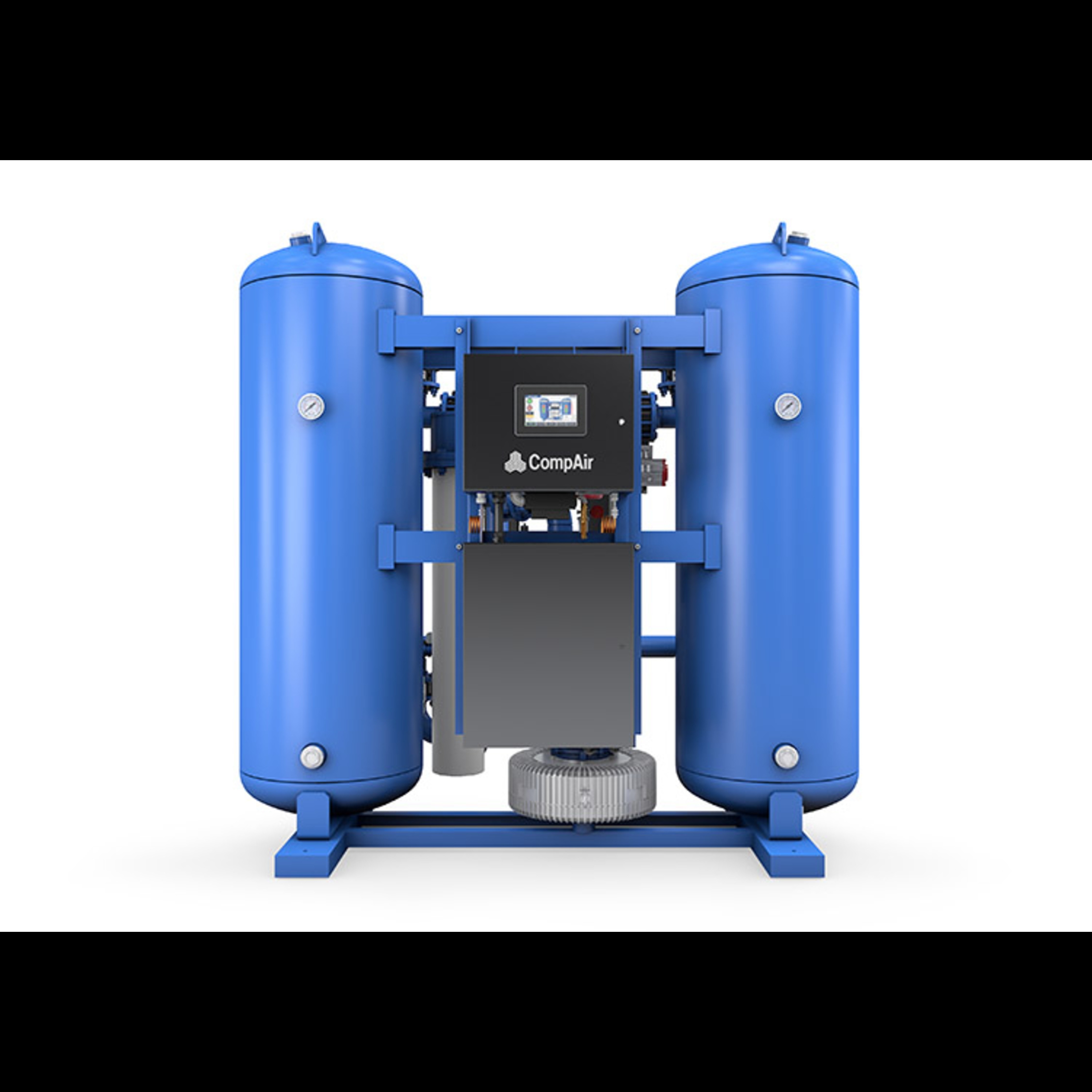
Desiccant Air Drying Technologies
Heated Blower Desiccant Air Dryers
High Performance. Maximum Reliability. Low Profile Design 500 - 14, 900 m3/h
🔥 Heated Blower Desiccant Air Dryers — Key Features
Heated blower desiccant dryers use heat to regenerate the desiccant material more efficiently. Traditional heatless dryers use a portion of dried air to regenerate the desiccant, whereas heated blower types use an external heater and air blower to reduce purge air usage.
✅ Core Advantages
Low operational cost
Reduced purge air consumption vs. heatless designs lowers compressed air loss.
Stable low dew point
Achieves very low pressure dew points (often −40°C to −70°C or better).
Energy efficient
Heat regeneration is more controlled and targeted.
Reliable
Fewer thermal stresses on desiccant — longer media life.
Wide capacity range
From small industrial needs (≈500 m³/h) up to large production lines (≈14, 900 m³/h).
📊 Typical Operating Principle
Adsorption phase:
Compressed air enters a desiccant chamber → water vapor sticks to the desiccant → dry air exits.
Regeneration phase:
A blower draws ambient air through a heater. Heated air flows through the saturated desiccant to remove moisture.
Cool-down & shift:
The desiccant bed cools and air flow switches to the alternate chamber — allowing continuous drying.
📈 Performance Highlights (Typical Ranges)
Feature Typical Value / Range
Capacity 500 — 14, 900 m³/h
Pressure Dew Point −40°C to −70°C (higher performance models can go lower)
Operating Pressure ~7–12 bar(g) (varies by design)
Pressure Drop Low (design optimized for high flow)
Regeneration Power Source Electric heater + blower
Control System PLC with timers or dew-point control
Exact specs depend on manufacturer, model, and options (controls, filters, special materials, etc.).
🎯 Where They Are Best Used
Desiccant dryers like these are ideal for:
Instrumentation air
Pharmaceutical production
Food & beverage (packaging)
Electronics / semiconductor processes
Painting / powder-coating operations
Compressed air for pneumatics in cold climates
⚙️ Why Choose Heated Blower Desiccant Dryers vs Others
Feature Heatless Heated Blower Refrigerated
Purge Air Loss High Very Low Essentially none
Energy Use Moderate Lower Low
Minimum Dew Point ~−40°C ~−70°C ~2–10°C
Best For Continuous duty High dew point requirement with efficiency General plant air
Heated blower designs hit the sweet spot: excellent dew point performance with much lower wasted air than heatless — making them a good choice for higher flow and precision applications.
🛠️ Design & Reliability Traits
Low-profile footprint — fits better in confined plants.
Modular construction — easy maintenance and parts replacement.
Advanced controls — allow dew point monitoring and efficient switching.
Robust blowers & heaters — built for continuous industrial duty.
🔍 Choosing the Right Model
When selecting a system, consider:
✔ Required flow capacity (m³/h)
✔ Desired pressure dew point
✔ Inlet conditions (temperature, humidity)
✔ Operating pressure & uptime requirements
✔ Energy costs and efficiency goals
✔ Serviceability and local support
If you want, I can also:
📌 Compare specific manufacturer models
📌 Provide selection guidelines or sizing help
📌 Explain installation tips & common pitfalls