Desiccant Air Drying Technologies
Twin Tower Heatless Desiccant Dryers
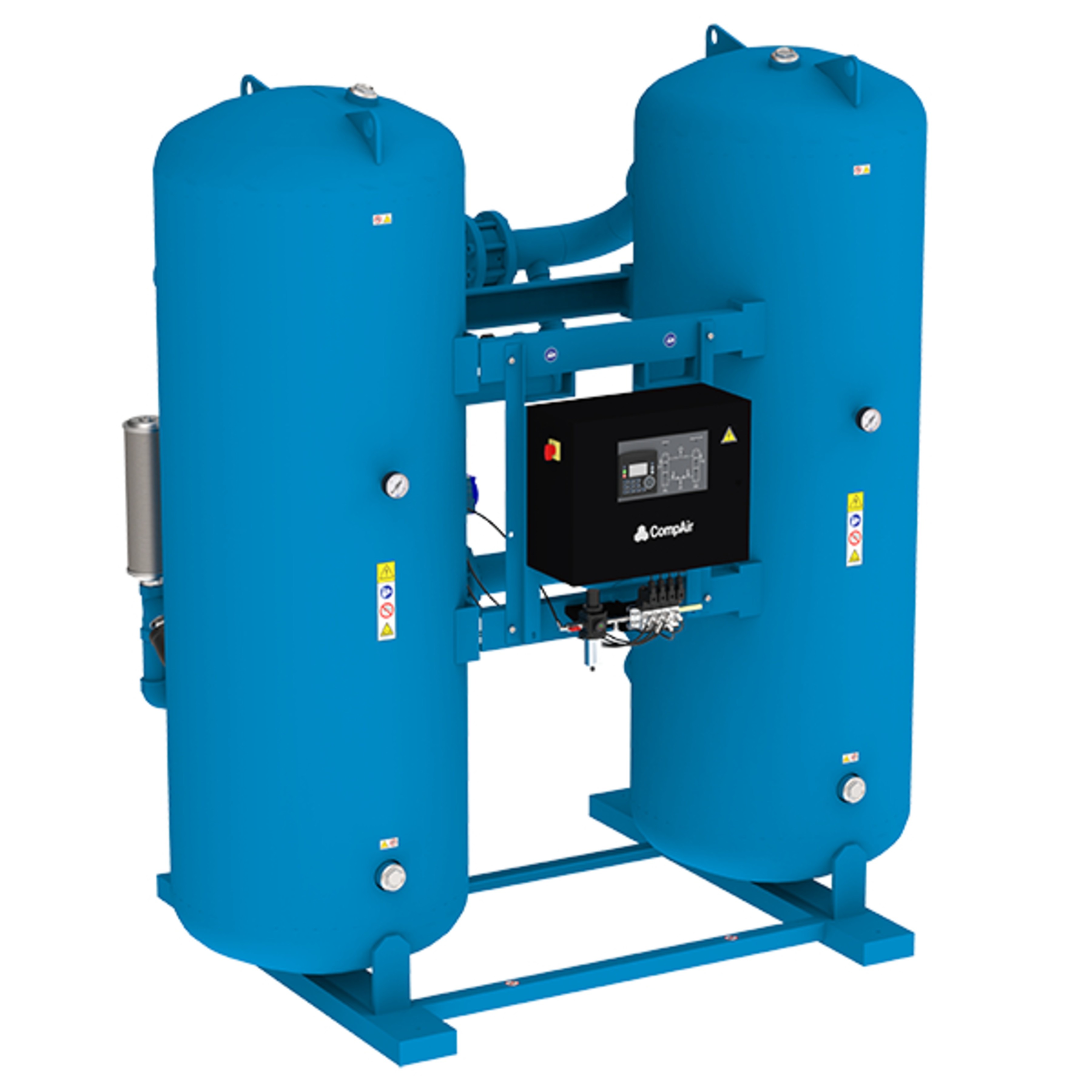
The CompAir AX-Series uses twin desiccant towers and strategically positioned valves to dry the compressed air.
The compressed air produced is thoroughly dried as it is directed through the on-line desiccant-filled tower of the dryer. As the desiccant in this tower adsorbs moisture from the air, the desiccant in the dryer’s offline tower is purged of moisture and readied for use.
Advantages at a glance:
High Reliability - proven technology used in thousands of applications and installations worldwide.
Low Capital Investment - large range, available for precise sizing to suit your needs.
High Air Quality - pre and post filter included, helping you to meet stringent air quality requirements.
Energy Efficient - with the optional high efficiency Energy Management System (EMS) offers even greater efficiency.
Standard features include:
High Efficiency Pre Filter and Dust Filters
IP54 electrical enclosure
Digital controller
Tower pressure gauges
Colour change moisture indicator
Optional features include:
Energy Management System (EMS) with dew point display
Fail-to-Shift alarm - Monitors the dryer sequencing functions to ensure proper dryer operation by sensing the pressure in each tower, sending an alarm in case of anomalies. This option is available from models 1000m3/h and above
IP65 electrical rating plus stainless steel control box
4-20 mA signal (requires EMS) is available should you need to get 4-20mA to your SCADA system
Different tower vessels design code
Stainless steel control air tubing
Filter monitoring - Differential pressure switches installed on filter monitor performance. Display options include analog and digital
-70˚C pressure dew point
No air loss drain for filters with alarm
Marine paint
Basic Concept:
Two vertically stacked or side-by-side towers filled with desiccant.
One tower is in drying mode while the other is in regeneration mode.
A small portion of the dry compressed air is diverted to regenerate (purge) the saturated desiccant in the offline tower — hence “heatless” (no external heater).
⚙️ 3. How It Works — Step-by-Step
🟢 Drying Phase (Primary Tower Active)
Compressed air flows into Tower A → Moisture is adsorbed by desiccant → Dry air exits with low dew point.
🔄 Regeneration Phase (Secondary Tower)
Simultaneously, Tower B unloads moisture:
A portion (typically 10–15%) of dry air from Tower A is routed to Tower B.
This dry air flows counter-current (opposite direction), purging the moisture out of the desiccant.
Moist purge air is expelled to the atmosphere.
🔁 Switching
After a timed cycle, the towers switch roles: Tower B dries and Tower A regenerates.
🧠 4. Core Components
Desiccant Beds: Activated alumina, silica gel, molecular sieve (commonly 4A or 13X).
Inlet/Outlet Valves: Direct flow between towers.
Purge Flow Control: Regulates purge air during regeneration.
Timers/Controllers: Manage tower switching.
Filters: Coalescing pre-filters and particulate post-filters to protect desiccant.
📊 5. Performance Characteristics
Feature Typical Range/Value
Outlet Pressure Dew Point (PDP) –40 °C to –70 °C
Maximum Operating Pressure Typically up to 10–16 bar
Regeneration Air Use ~10–15% of dried air
Cycle Time ~4–8 minutes per tower (configurable)
Operating Temperature ~1–50 °C ambient
🆚 6. Advantages
✅ Low Dew Point: Suitable for very dry air requirements.
✅ Simple Design: Less complex than heated dryers.
✅ No Heater Required: Reduces maintenance and electrical load.
✅ Reliable: Continuous drying with alternating towers.
⚠️ 7. Limitations / Considerations
🔹 Purge Air Loss: 10–15% of dry air is consumed in regeneration; increases operating cost.
🔹 Pressure Drop: Can affect compressor loading.
🔹 Not Ideal for Wet Inlet Air: Pre-drying (e.g., refrigerated dryer or after-cooler + separator) is recommended to protect desiccant and optimize performance.
🔹 Ambient Requirements: Very low ambient temperatures might require insulation or shelter.
🔄 8. Comparisons with Other Technologies
Technology Heatless Heated (External) Heat Regenerated (Electric) Blower Purge
Purge Air Consumption High Moderate Very Low Very Low
Electrical Load None Medium High Medium
Dew Point Capability Excellent Excellent Excellent Very Good
Best For Smaller / Medium Plants Larger Systems High Duty Industrial Very Large Systems
🧩 9. Where They Are Used
✔ Instrument air for instrumentation & control
✔ Paint booths & coating applications
✔ Pneumatic tools and valves
✔ Electronics manufacture & packaging
✔ Drying processes requiring low humidity
✔ Automotive & aerospace facilities
🔁 10. Tips for Best Operation
• Pre-dry compressed air before desiccant dryer.
• Monitor inlet temperature & pre-filter condition.
• Change desiccant periodically based on moisture carryover or pressure drop rise.
• Set proper cycle timing for load conditions.
• Install dew point sensor to verify performance.